Mythical Creatures in Clay
Inspired by a transformative journey to Turkiye, this collection emerged from my fascination with Turkish traditions of depicting mythical beings—creatures that bridge cultures and carry ancient stories across centuries.
Each piece in this collection honours these timeless narratives while breathing new life into them through sculptural form. Working in clay allows these mythical creatures to emerge with tactile presence—ancient stories made tangible, inviting us to touch the legends that have shaped civilizations across the Mediterranean and beyond.
Shahmeran: Guardian of Wisdom and Transformation
These sculptural interpretations capture the essence of the Shahmeran (Shah of Snakes), one of Turkiye's most enduring mythological figures. Half woman, half serpent, she emerges from ancient Persian and Anatolian traditions as a symbol of profound wisdom, healing knowledge, and the liminal space between human and natural worlds.
The Myth
The legend tells of Tahmasp (Camsap in Turkish), a young man who accidentally discovers the underground kingdom of serpents while gathering firewood with companions. There he encounters the Shahmeran, a queen of extraordinary beauty and infinite knowledge who has lived for centuries, acquiring wisdom from the earth itself. She takes him as her companion and shares her secrets with him. Eventually, Tahmasp returns to the human world, carrying her trust and silence about her location.
When the sultan's vizier falls gravely ill, court physicians declare that only the flesh of the Shahmeran can cure him. Under torture, Tahmasp reveals her whereabouts. The Shahmeran, knowing her fate, instructs Tahmasp on how to consume her remains so that her wisdom will pass to him rather than to the corrupt vizier. In her sacrifice, she transforms from victim to victor, ensuring her knowledge serves justice rather than tyranny.

Contemporary Resonance

In recent years, the Shahmeran has experienced a remarkable renaissance as a symbol of resistance and transformation in Turkish political and cultural discourse. LGBTQ+ communities have embraced her as an icon of gender fluidity and non-conformity—a being who exists between categories, defying binary classifications. Her hybridity speaks to queer identity, her underground realm to marginalised communities forced to exist in hidden spaces.
Feminist movements have similarly reclaimed the Shahmeran as a figure of female power, autonomy, and intellectual authority. In a society where women's bodies and choices remain contested terrain, the Shahmeran represents a woman who rules her own domain, possesses knowledge surpassing that of male authorities, and chooses her own fate even in death.
This symbolic potency has not gone unnoticed by authorities. In recent years, there have been reported arrests and censorship related to artistic interpretations of the Shahmeran, particularly those explicitly linking her to LGBTQ+ pride or feminist resistance. The image that once adorned folk art and coffee houses now carries the weight of contemporary political meaning, transforming an ancient myth into a living symbol of dissent.
In these sculptures, the Shahmeran crowned head and scaled body remind us that wisdom often comes from those who exist at the margins, and that transformation—both personal and political—requires us to embrace what society deems monstrous or other.
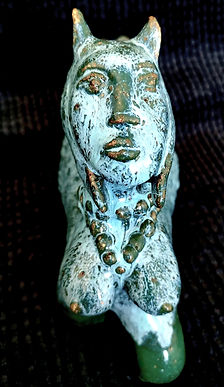
al-Buraq
In Islamic tradition, al-Buraq is the celestial mount that carried the Prophet Muhammad on the miraculous Night Journey from Mecca to Jerusalem and through the seven heavens. The name derives from the Arabic word for “lightning,” reflecting the creature’s extraordinary speed—said to place each hoof at the farthest point the eye could see.
This work is al-Buraq in her most ornate form: a radiant winged creature with a woman’s face and chest, and a regal peacock tail. These feminine features emphasise the creature’s grace and beauty, while the magnificent peacock plumage—a common motif in Islamic depictions—symbolises paradise, divine glory, and the splendour of the heavens themselves. The birdlike wings speak to al-Buraq’s role as a celestial being, bridging earthly and heavenly realms.
Al-Buraq embodies divine grace and supernatural power, representing not just speed and beauty, but the miraculous connection between the mortal and the divine. Throughout Islamic art and folklore, this noble steed has been portrayed in countless ways—sometimes adorned with jewels and always luminous and awe-inspiring—remaining one of the most beloved figures in Islamic artistic tradition, symbolizing spiritual ascension, divine favor, and the transcendent journey of the soul.
Echoes of Troy
These pieces refer to ancient legends and landscapes of Turkiye, inspired by a recent journey to the historic ruins of Troy. Crafted in clay with a distinctive turquoise-green patina reminiscent of aged bronze, the pieces capture the enduring spirit of the horse in Turkish culture—from the legendary Trojan Horse to the noble steeds that have traversed Anatolia for millennia.
These handcrafted pieces bridge past and present, bringing the mystique of Troy's archaeological wonders into contemporary sculptural form. The oxidized patina creates an artifact-like quality, inviting viewers to contemplate the timeless connection between art, history, and the enduring power of myth.


The Siren
These pieces are intended to reflect the haunting figure of the Siren from Turkish and broader Mediterranean mythology—a creature bearing the body of a bird with the head and chest of a woman. In ancient tales, these liminal beings inhabited rocky coastlines and perilous waters, their ethereal voices carrying across the waves to lure unsuspecting fishermen toward destruction.
These pieces embody a duality of attraction and danger. The textured, earthen quality of the bird's body suggests something ancient and elemental, while the smooth form of the female figure speaks to an otherworldly allure. Suspended as if caught between sea and sky, the Siren serves as both temptress and harbinger—her song a warning wrapped in beauty.
In Turkish coastal folklore, these creatures were seen not merely as monsters but as guardians of thresholds, testing the resolve of sailors and fishermen who ventured too far from safe harbours. The Siren's call represented the treacherous seduction of the unknown, reminding mortals that some mysteries are meant to remain untouched. The Sirens I create in clay are intended to honour this complex legacy - the Siren in her eternal vigil—part warning, part wonder, forever calling across the boundary between human and divine.
You will notice that my interpretation of a Siren as represented in different clayworks, whilst following the ancient myths, are different. Each piece is unique in various ways.
Minotaur
In Greek mythology, the Minotaur was a creature with the head of a bull and the body of a man.
The story begins with King Minos of Crete, who prayed to Poseidon for a sign of his right to rule. Poseidon sent a magnificent Cretan Bull from the sea, under the condition that Minos sacrifice it back to him. However, Minos found the bull too beautiful and kept it, sacrificing a lesser bull instead.
Infuriated, Poseidon cursed Minos’s wife, Pasiphae, to fall in love with the bull .She arranged the construction of hollow wooden cow for her to hide inside. The bull mounted the wooden horse and from this union the Minotaur was conceived and born.
The Labyrinth
As the creature grew, it became violent and fed on human flesh. Ashamed and fearful, Minos built the Labyrinth, a vast and impossible maze beneath the palace at Knossos, to imprison the beast.
After defeating Athens in a war, Minos forced the city to pay a gruesome tribute: every nine years, seven young men and seven young women were sent into the Labyrinth to be devoured by the Minotaur.
The cycle was broken when the Athenian hero Theseus volunteered to be part of the sacrifice. Upon arriving in Crete, Minos’s daughter, Ariadne, fell in love with him. She gave Theseus a ball of thread to mark his path and a sword. Theseus navigated to the heart of the maze, slew the Minotaur in a fierce battle, and used the thread to return to the entrance.
